It has all come down to this, Week 10 of the 10-period banding season in Texas! Today was our first day of the 10th period. A slow start because of thunderstorms yesterday morning. Followed by more thunderstorms this afternoon and hopefully not any more this week. I've scheduled myself to hit the road by next Thursday night so I'm hoping everything can be wrapped up by then.
Back to the last period, Phase 9, we had quite a bit more success than the week before. We ended the week with a 15-bird day, which is pretty decent. Including one CRAZY "net-run." We typically check our nets for any birdies every 40 minutes and it's one person per five nets. Usually I can handle that. But at 6:40 I went to check the nets and I had a bird in every net except one which only had 2 fat cicadas which I also had to extract. I was extracting my fifth bird on my fifth net, and another bird flew right in. Total of 6 birds in one net check. I ran out of birdy bags to transport the birds back so I just held on to the poor little wren. So I ended up with a Carolina Wren, 3 Cardinals (including 2 juveniles), a Mourning Dove and a Bewick's Wren. I was pretty exhausted after extracting all those birds! At least it made for a fun day.
In contrast, today was mostly dull since we were at our slowest site. I spent most of the time reading a new book that was a gift from my aunt Leslie (Thanks Leslie!),
Life List by Olivia Gentile. The book is a biography of Phoebe Snetsinger, a record-holding life lister, meaning she had seen and kept records of over 6,000 birds in her lifetime. So far it is an interesting read about a woman who begins birding as a hobby to escape her life as a 1960's housewife. But after being diagnosed with melanoma, her time is cut short. She vows to spend her remaining days birding all over the world with help from an inheritance after her wealthy father's death.
Today when I got to extract a bird that looked like a mysterious warbler I couldn't immediately identify, I definitely felt a rush of excitement. And I can see how identifying birds can turn from passion to obsession and fanatacism. According to the biography, Phoebe Snetsinger definitely crossed that line. It came to a point where she was rarely ever at home with her family and she was putting herself in very dangerous situations just to see birds. For instance, she was raped and almost killed during a trip to Papua New Guinea.
I can see why she would pursue a hobby so much, since she was given a short time to live and she didn't have any other outlet or career, but I wouldn't choose it for myself. I have to wonder if she would have enjoyed banding though. I find it much more rewarding than just birding, since you are doing something to help monitor bird populations rather than just trying to see them.
Also, I have to note, it is not always very helpful for birds when birders get excited about seeing a rare bird. Birders will flock to the rare bird's location and may disrupt it or call attention to predators. Most birders, of course know that there is a birders' code of ethics though, and they know not to harrass birds or have an overabundance of people trying to view an endangered species.
Although I'm not a fanatic, I do absolutely love watching birds and seeing a new species I have never seen before. I have already seen several new ones this summer including the Worm-eating Warbler, Blue Grosbeak, Green Jay and Olive Sparrow- just to name some of my favorites! I have some kind of life list but it is very casual and I'm sure it has huge holes in it from birds I have seen in Costa Rica, Florida and Arizona, my checklists and notes are somewhere at my parents' house. Anyway I have been using a great website,
http://www.birdpost.com/, that allows you to list all your birds and where and when you've seen them. My list just has some of
what I have seen but doesn't go into detail. So far my number is 332! If you use the site, my username is SongbirdSpiffy if you care to track what my favorite birds are or whatever!
Wow, this has been a wordy post so I'm sure you're looking for the birdy part of it. Remember I said something about a mysterious warbler that I got to extract today? Ah yes my favorite part of today, aside from being out for 12 hours, 2 hours of taking down net poles, another flat tire etc.
Well here is the lovely warbler. Like pretty much every bird we've been getting lately, she was molting like crazy too. All the more helpful for people trying to identify it (not quite).

Despite having no clue while extracting this bird, it was fairly easy to identify once I brought it back to our banding station. Blueish color with white wingbars? Incomplete eyering? Yellow breast with a reddish bar? Yellow lower mandible? Yellow feet and black legs? All fieldmarks for the Northern Parula.

Northern Parula
OK, I have words and birds, so next time I update I promise whims aplenty.


 Yes my Brownwood bedroom came with some nice fake wood paneling
 Ta-da! According to the pattern, I'm supposed to add little buttons to complete the owl eyes. I don't have any buttons right now but maybe sometime later after I get home I will find some owl-eye buttons. I'm really happy how it turned out though. I will have to wait awhile to wear it though, not much use in the 100 degree Texas heat!!


 In general, when it comes to age and sex, birds can be rather difficult. The best way of knowing for sure what a bird's sex is, is by getting a DNA sample. And the best way to determine age is if you capture a bird when it's born and then recapture it in successive years. But when it comes to Painted Buntings, there are a lot of clues that you can look for. For instance, we know the above picture is an adult male. In the bird world, it's typical for males to be bold and bright.
 And we know for sure this picture above is a female Painted Bunting. Or is it? Males in their second year of life actually look a lot like the females. They don't molt into their full breeding plumage until their third year!


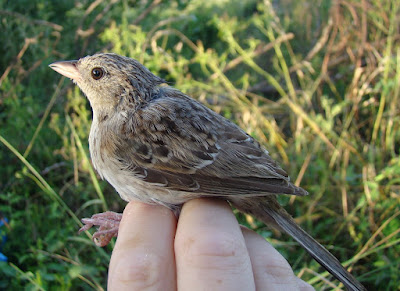


 Cassin's Sparrow
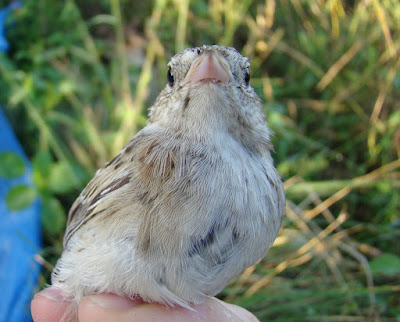
 Dickcissel juvenile


 and the Cerulean Warbler (per request of MAPS biologist Tiffany!)