Common Ravens at Petrified Forest National Park in Arizona



 Tail looks more reddish & contrasting with body plumage, plus the thin eye-ring + lack of the noticeable "buffy spectacles" over the bill are all leading me to believe it is a Hermit Thrush, but otherwise possibly Swainson's. They are tricky ones to ID.


 We got quite a few migrants and young birds like this juvenile Red-eyed Vireo. It was neat to see the difference in eye color with the young vireos. Their eyes are dark brown and will turn red next year.
 We caught this little guy, a Tennessee Warbler which can be very easily confused with another bird that we catch a lot of. Below is a picture of a female Common Yellowthroat. You can see how the Tennessee and the Yellowthroat both have whitish to buffy eyerings and yellow bellies! The biggest difference here though is size. The Tennessee Warbler is a very tiny warbler whereas the Yellowthroat is a bit more robust. It's too bad we didn't catch these two at the same time so I could have gotten a side-by-side comparison. But you'll also notice that the Tennessee has yellow all the way down its breast while the Yellowthroat has more yellow on the throat (surprise!) and is whiteish below.
 Female Common Yellowthroat

 OK, I'm a little behind in updating my blog! But a week ago I had the great opportunity to learn about raptor research techniques at the Linwood Springs Research Station in Stevens Point, Wisconsin.

 We almost caught a Merlin as well, a larger bird also in the falcon family. That would have been pretty neat, but the Merlins were not as interested in our traps. In order to trap birds, we used two methods: finding the raptors first and setting a trap or setting the trap first and then waiting for raptors to fly in. The first method used a type of trap called a "bal chatri," which is a cage covered in tiny nooses that get caught on a predator's feet. The cage has the bird's lucky prey item, usually a mouse from a pet store. Really, the mice are hardly ever harmed by the birds, but I wouldn't worry about it since most pet store mice end up being snake food or something of the sort anyway!

 Here I am with a juvenile Red-tailed Hawk. Notice that the tail is brown rather than reddish.
 And here I am with an adult Red-tailed. This guy took a little longer to come to our trap. They get a little smarter with age and more suspicious of prey inside of a funny cage.
 In order to calm the raptors and keep them from flapping while we band and take measurements, we would use coffee cans to secure them. Just look at those tail feathers. This hawk had two generations of red feathers, meaning it was at least 3 years old.

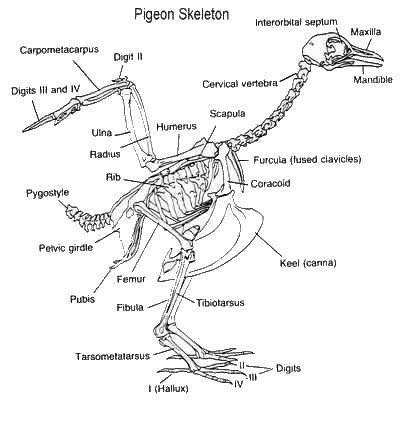
The tarsus (same as tarsometatarsus) is the foot bone, but many people call it the bird's "leg," since it is the most visible part of the bird leg. As you can see though, birds walk on their toes rather than their feet, just like cats and dogs. The femur and often the fibula & tibiotarsus disappear within all those feathers. So if you ever say someone has "chicken legs" you're probably comparing the person's legs to a bird's skinny feet. But if you ever eat a chicken leg, you're most likely eating the meaty area that makes up the thigh of the bird.
That's all for now for the anatomy lesson, I'll be back later so I can post some pictures from my most recent excursion to a Raptor Banding Class.
I saw my first American Dipper while at the Rocky Mountain National Park in Colorado, North America's only songbird that can swim!


(Bewick's on the Left, Carolina on the Right)
5. Learned that Mourning Doves shed a lot of feathers when they EXPLODE! (see image at the top)
6. There's no pain quite like a Cardinal biting your cuticles
 (Don't ever get too close to that beak!)
7. A lot of people in Texas have never seen a Painted Bunting, or if they have they think it's an escaped pet! They are all over the place, you just have to look!
8. It is OK to only check email 3 times a week
9. Learned how to do the Texan "two-step"
10. Learned so much about extracting and aging techniques for all birds!